
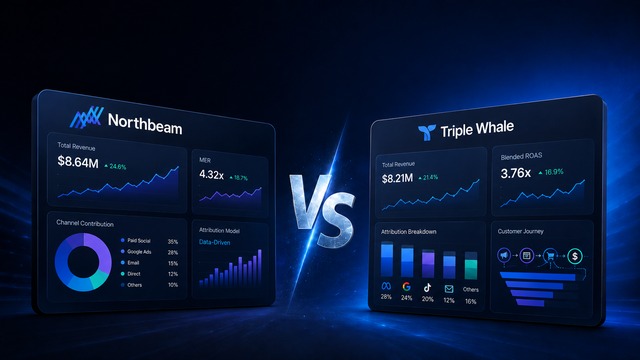
Choosing between Triple Whale and Northbeam can be a major decision for Shopify brands investing in paid advertising. Both platforms help e-commerce businesses understand marketing performance, measure customer journeys, and evaluate which channels contribute to sales. However, they differ in their approach to analytics, attribution, reporting, and business intelligence.
Triple Whale combines attribution with broader e-commerce analytics and operational reporting. Northbeam focuses more heavily on marketing measurement, multi-touch attribution, and advanced analysis for brands with complex advertising strategies.
This comparison examines Triple Whale vs Northbeam in 2026, including pricing, features, attribution models, usability, and the types of Shopify stores that may benefit most from each platform.
Quick Verdict: Triple Whale or Northbeam?
Triple Whale
Best for Shopify merchants who want attribution, sales analytics, profit insights, and marketing reporting in a centralized platform.
- Free entry option available.
- Shopify-focused reporting.
- First-party tracking and attribution models.
- Broader analytics and AI-powered workflows.
Northbeam
Best for brands with substantial, diversified advertising budgets that need sophisticated cross-channel measurement and deeper media analysis.
- First-party multi-touch attribution.
- View-through measurement options.
- Media mix modeling on eligible offerings.
- Advanced measurement for larger marketing teams.
Triple Whale vs Northbeam: Feature Comparison
| Feature | Triple Whale | Northbeam |
|---|---|---|
| Primary focus | E-commerce analytics, attribution, and business performance | Marketing attribution and measurement |
| Shopify integration | Shopify-focused platform and app | Supports Shopify, with broader platform support on applicable plans |
| Attribution | First-party tracking and multiple attribution models | First-party multi-touch attribution and modeled measurement |
| View-through measurement | Available through supported attribution models and features | Clicks + Deterministic Views option on supported channels |
| Media mix modeling | Available through Compass offerings, subject to plan | Available on eligible higher-tier offerings |
| Incrementality | Available through eligible measurement offerings | Available through eligible plans and measurement services |
| Profit analytics | Broader commerce and profit reporting capabilities | Primarily focused on marketing measurement |
| AI capabilities | Moby AI and related workflows, depending on plan | Measurement-focused analytics and supported integrations |
| Entry pricing | Free plan; paid plans available | Sales-led pricing; published starting prices may apply |
| Ideal team | Founders, growth marketers, and e-commerce operators | Performance marketing and analytics teams |
Feature availability varies by subscription, integration, and product updates. Confirm current plan details directly with each provider before making a purchase.
1. What Is Triple Whale?
Triple Whale is an e-commerce analytics and measurement platform built around the needs of direct-to-consumer brands. It brings together store data, advertising performance, attribution, and business reporting to help merchants make decisions using a more consolidated view of their operations.
Its Triple Pixel provides first-party tracking capabilities, while its attribution tools help merchants compare different ways of assigning credit to marketing touchpoints. Beyond attribution, the platform offers additional analytics and AI-powered functionality.
Key Triple Whale Features
- Attribution models: Compare first-click, last-click, and supported multi-touch approaches.
- Triple Pixel: Collect first-party shopper interaction data for supported measurement workflows.
- Profit and sales analytics: Bring together important store and marketing performance metrics.
- Creative analytics: Evaluate advertising creative and campaign performance.
- AI-powered insights: Use Moby AI and eligible features to explore business performance.
- Additional analytics: Access supported reporting, customer, product, and business intelligence capabilities.
Triple Whale Pricing
Triple Whale offers a free entry option and paid plans. Pricing and feature access depend on the current package, store requirements, and billing terms.
Published third-party comparisons in October 2026 have listed the Foundation plan at approximately $219 per month and the Automate plan at approximately $749 per month. These figures should be verified against the current official pricing and Shopify App Store listing before budgeting.
Triple Whale Pros and Cons
Advantages
- Accessible starting point for Shopify merchants.
- Combines several analytics functions in one environment.
- Useful daily reporting for founders and marketers.
- Offers broader operational capabilities beyond attribution.
Limitations
- Advanced features may require higher-priced plans.
- Attribution remains dependent on data quality and modeling assumptions.
- Some larger businesses may require specialized measurement workflows.
- Users still need to validate platform-reported results.
Best for Shopify brands seeking an all-in-one analytics platform
2. What Is Northbeam?
Northbeam is a marketing intelligence and attribution platform designed to help e-commerce brands evaluate how advertising channels contribute to business outcomes. It is particularly relevant to companies that spend across multiple paid media channels and need a deeper understanding of performance beyond the reporting provided by individual advertising platforms.
Northbeam combines first-party tracking with multi-touch attribution and offers advanced measurement options on eligible plans. These can help sophisticated marketing teams investigate view-through effects, channel contribution, and broader media performance.
Key Northbeam Features
- Multi-touch attribution: Distribute conversion credit across customer touchpoints.
- First-party tracking: Connect supported customer journeys and purchase activity.
- View-through measurement: Analyze supported advertising views even when a user does not click.
- Media mix modeling: Estimate channel contribution using aggregate data and statistical methods on eligible offerings.
- Incrementality testing: Support measurement of the additional impact associated with advertising.
- Marketing intelligence: Help teams compare channel and campaign performance.
Northbeam Pricing
Northbeam generally uses sales-led pricing, with costs depending on the selected plan, data volume, advertising scale, and required capabilities.
Public comparisons published in October 2026 have cited starting prices around $1,500 per month for Starter and $3,500 per month for Professional. These are indicative published figures rather than guaranteed quotes. Contract terms, eligibility, and pricing should be confirmed with Northbeam.
Northbeam Pros and Cons
Advantages
- Designed for sophisticated cross-channel measurement.
- Offers supported view-through attribution capabilities.
- Advanced measurement options for eligible plans.
- Useful for teams with dedicated analytics resources.
Limitations
- Higher potential entry cost than a free analytics platform.
- Advanced models can require more expertise to interpret.
- Some capabilities are restricted to higher-tier offerings.
- May be excessive for stores with small budgets and simple channel mixes.
Best for brands with complex paid media and measurement needs
3. Attribution Models: How Do the Platforms Differ?
Attribution determines how credit for a purchase is assigned to marketing interactions. A customer might see a social media advertisement, click a search result, receive an email, and later complete a purchase. Different models can assign different amounts of credit to those interactions.
Triple Whale Attribution
Triple Whale offers multiple attribution approaches designed to help merchants analyze the customer journey. Its platform combines first-party tracking with supported models that can be used to compare marketing performance and guide daily decisions.
This can be useful when a Shopify brand needs a centralized way to compare paid channels, analyze campaigns, and understand how marketing activity relates to store revenue.
Northbeam Attribution
Northbeam focuses on cross-channel marketing measurement and offers multi-touch attribution models, including supported approaches for deterministic view-through measurement. This can be valuable when advertising impressions may influence purchasing behavior without producing a direct click.
Its advanced measurement offerings can also help larger teams investigate channel contribution beyond individual conversion paths.
Which Attribution Approach Is Better?
Neither platform should automatically be considered more accurate in every situation. The result depends on tracking implementation, the available data, attribution settings, channel mix, and the assumptions behind each model.
For a Shopify store that needs daily operational reporting, Triple Whale may be easier to integrate into routine decision-making. For a larger brand that needs more advanced cross-channel measurement, Northbeam may offer a better fit.
4. Triple Whale vs Northbeam Pricing
Pricing is one of the most important differences for Shopify merchants. A platform should be evaluated according to its total cost and the value it provides, rather than the number of features shown in a sales presentation.
| Pricing Consideration | Triple Whale | Northbeam |
|---|---|---|
| Entry option | Free option available | Generally requires a sales conversation |
| Published paid pricing | Some plans have publicly listed prices | Starting prices may be published; quotes vary |
| Pricing variables | Plan, store requirements, and features | Plan, data volume, advertising scale, and capabilities |
| Contract considerations | Check monthly versus annual billing | Check commitment period and plan-specific terms |
| Additional expenses | Consider other tools and integrations still needed | Consider analytics, implementation, and data infrastructure needs |
Which Tool Offers Better Value?
Triple Whale will often be easier to justify for a smaller Shopify brand because it offers a lower-cost starting point and a broader set of analytics functions. Northbeam may justify its higher cost when advanced measurement can improve decisions across substantial advertising spend.
A sensible purchasing decision should compare the monthly fee, onboarding, internal staff time, required integrations, and expected financial benefit. If a platform does not change marketing decisions, its sophisticated features may not provide enough value.
5. Which Tool Is Better for Small and Large Shopify Stores?
Small Shopify Stores
Smaller stores often need reliable sales reporting, consistent conversion tracking, and a clear understanding of their main advertising channels. Before investing in an expensive attribution platform, merchants can use Shopify reports, Google Analytics 4, consistent campaign tagging, and advertising platform diagnostics.
If additional attribution is necessary, Triple Whale’s entry option provides a way to explore its workflow before committing to a more expensive solution.
Growing Direct-to-Consumer Brands
Brands that advertise on Meta, Google, TikTok, and other channels may need a centralized view of spending and sales. Triple Whale is attractive when a team wants to combine attribution with profit analytics and daily operating reports.
Northbeam is worth evaluating when the brand’s media mix becomes more complicated and the marketing team needs deeper measurement to inform budget allocation.
Enterprise Shopify Businesses
Large businesses may need to analyze multiple markets, advertising channels, product categories, and customer acquisition strategies. They may also have analysts who can interpret modeling results and conduct controlled experiments.
Northbeam may be suitable for these measurement-intensive requirements, while Triple Whale may be attractive when broader analytics and operational reporting are equally important. Enterprise buyers should compare the exact plan scope and implementation requirements of both platforms.
6. Accuracy, Data Quality, and Incrementality
Attribution software is useful, but it does not provide a perfect record of every factor that caused a purchase. Browser restrictions, consent choices, cross-device activity, missing campaign parameters, and inconsistent tracking can affect the available data.
Why Attribution Numbers Differ
- Different attribution windows may assign credit to different interactions.
- Advertising platforms may each claim credit for the same sale.
- Some customer journeys cannot be observed completely.
- View-through models may estimate the influence of ad impressions.
- Refunds, reporting delays, and event duplication can create discrepancies.
What Is Incrementality Testing?
Incrementality testing investigates whether advertising generates additional purchases that would not otherwise have happened. This differs from attribution, which assigns credit to recorded or modeled marketing interactions.
Controlled holdout experiments or suitable geographic tests can provide stronger evidence of incremental impact than relying on an attribution dashboard alone. Both platforms may support advanced measurement options, but the availability of specific tests depends on the offering and implementation.
7. Interactive Tool Selector: Which Platform Fits Your Store?
Select the characteristics that best describe your business to see a general recommendation.
Recommended starting point: Triple Whale
A growing Shopify brand may benefit from centralized commerce analytics and attribution. Compare the plan’s actual capabilities and costs against the current setup.
This selector is a general guide, not an assessment of either vendor’s measured accuracy or guaranteed return on investment.
8. Alternatives to Consider Before Paying for Attribution
Not every Shopify store needs a dedicated attribution subscription. Some businesses can answer their most important questions using a smaller analytics stack.
- Shopify Analytics: Review orders, products, sales, and customer metrics within the store platform.
- Google Analytics 4: Measure traffic acquisition, e-commerce events, and conversion paths.
- Microsoft Clarity: Investigate user behavior through heatmaps and session recordings.
- Advertising platform reporting: Monitor campaign delivery and platform-specific conversions, while recognizing that platforms may use different attribution rules.
- Post-purchase surveys: Ask customers how they discovered the brand to collect an additional perspective on acquisition.
These tools do not fully replace specialist multi-touch attribution or media mix modeling. However, they can establish a stronger measurement foundation before a business commits to more expensive software.
Frequently Asked Questions
Is Triple Whale better than Northbeam for Shopify?
Triple Whale is often a practical choice for Shopify brands that want attribution alongside profit analytics and broader reporting. Northbeam may be a better fit for larger advertisers that need advanced cross-channel measurement. The best option depends on the store’s budget, advertising complexity, and internal resources.
How much does Triple Whale cost in 2026?
Triple Whale offers a free entry option and paid plans. Public comparisons have listed paid plans at approximately $219 and $749 per month for certain offerings in October 2026. Pricing and features may change, so check the current official listing before purchasing.
How much does Northbeam cost?
Northbeam uses sales-led pricing. Public comparisons in October 2026 have cited starting prices around $1,500 per month for Starter and $3,500 per month for Professional, subject to plan requirements and quote terms. Confirm current pricing directly with the provider.
Does Northbeam have a free plan?
Publicly available pricing information does not indicate a comparable free entry plan. Prospective customers should contact Northbeam to confirm available plans and eligibility.
Can Triple Whale and Northbeam replace Google Analytics 4?
They serve different measurement needs. Although their features may overlap with some website analytics reports, merchants may still use Google Analytics 4 for traffic acquisition, engagement, and event analysis alongside their attribution platform.
Which tool is more accurate?
Neither can be declared universally more accurate without a controlled, like-for-like evaluation on the same store and time period. Data quality, attribution windows, modeling assumptions, and channel mix all influence the results.
Can attribution software prove that an advertisement generated additional sales?
Attribution assigns credit to marketing interactions, while incrementality testing evaluates whether advertising caused additional outcomes. Controlled experiments provide stronger causal evidence than attribution reports alone.
Should a small Shopify store pay for an attribution platform?
Not necessarily. A smaller store may get sufficient insight from Shopify reporting, Google Analytics 4, consistent UTM tracking, and platform conversion diagnostics. Specialist software becomes more attractive when better measurement can materially improve decisions.
Final Verdict: Triple Whale vs Northbeam
Triple Whale and Northbeam both address the challenge of measuring e-commerce marketing performance, but they suit different operating needs.
- Choose Triple Whale if the priority is a Shopify-oriented platform combining attribution, store analytics, profit insights, and day-to-day reporting.
- Choose Northbeam if the priority is sophisticated cross-channel measurement and advanced attribution for a large or complex advertising program.
- Choose neither yet if the store still has inconsistent tracking, unclear campaign tagging, or insufficient data to justify another subscription.
For many Shopify businesses, Triple Whale is the more accessible starting point. Northbeam deserves serious consideration when a brand has the advertising scale, data quality, and analytical expertise to benefit from its measurement capabilities.
The most effective choice is the platform that improves real marketing decisions, fits the team’s workflow, and provides enough measurable value to justify its total cost.