
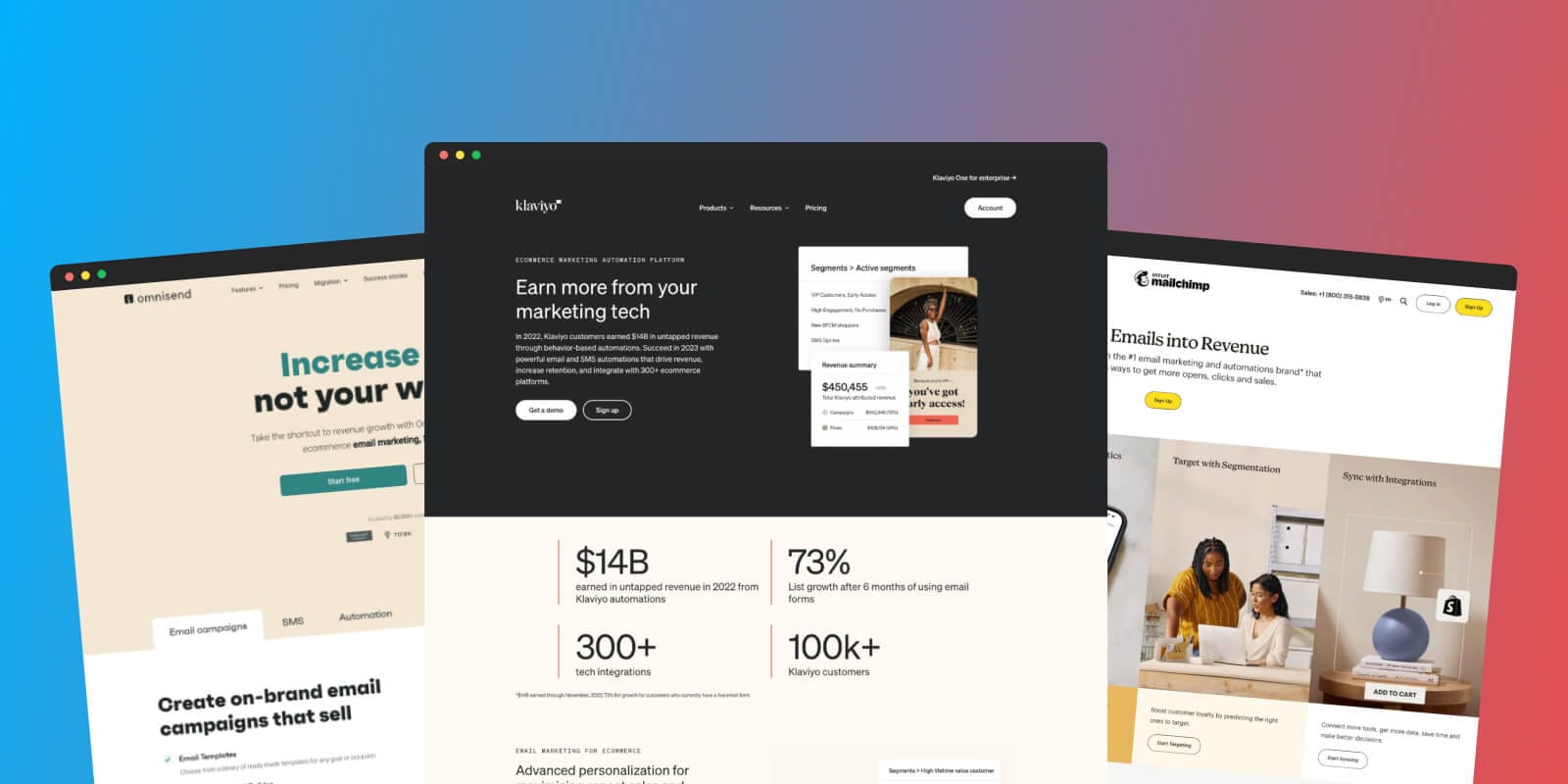
Choosing an email marketing platform is not just about sending newsletters. Online stores need reliable campaign reports, customer behavior tracking, conversion attribution, and actionable insights that help turn subscribers into repeat buyers.
This comparison explores how Klaviyo, Mailchimp, and Omnisend approach email analytics, where each platform stands out, and how ecommerce businesses can decide which solution fits their needs.
Quick Comparison: Which Email Analytics Tool Is Best?
Klaviyo
Strong ecommerce-focused analytics, detailed customer profiles, behavioral segmentation, and predictive insights for stores with meaningful customer data.
Best fit: Growing brands focused on customer lifetime value and revenue attribution.
Mailchimp
Accessible campaign reports, audience management, and marketing tools that can support ecommerce alongside other business activities.
Best fit: Small businesses that want email reporting without an ecommerce-only workflow.
Omnisend
Ecommerce-oriented campaign reporting and automation analytics, with email, SMS, and web push options in its multichannel approach.
Best fit: Online retailers that want to coordinate several customer messaging channels.
Analytics, automation, attribution, and reporting capabilities can vary by plan, integration, and account configuration. Confirm current feature availability before purchasing.
Comparison Table: Email Reporting and Ecommerce Analytics
| Analytics capability | Klaviyo | Mailchimp | Omnisend |
|---|---|---|---|
| Campaign performance | Detailed campaign and channel reporting | Campaign reports and performance dashboards | Campaign reports built around ecommerce use cases |
| Click and engagement tracking | Yes, with detailed audience segmentation | Yes, for evaluating campaign engagement | Yes, for campaign and automation analysis |
| Purchase and revenue analysis | Strong ecommerce revenue and customer analysis | Available through supported ecommerce integrations and plan features | Commerce-oriented sales and campaign reporting |
| Behavior-based segments | Advanced behavioral and purchase-based segments | Audience segments with capabilities depending on plan | Purchase and engagement-based segments |
| Predictive analytics | A major strength; availability depends on data and feature | Some predictive features are plan-dependent | Includes ecommerce-oriented audience and lifecycle tools; check specific predictive features |
| Automation reporting | Performance reporting for flows and customer journeys | Reporting for supported automated customer journeys | Automation reporting for ecommerce workflows |
| Multichannel marketing | Email and additional supported messaging channels | Email and other marketing channels depending on plan and region | Email, SMS, and web push capabilities |
| Typical learning curve | Moderate to advanced | Beginner-friendly for common tasks | Moderate, with ecommerce-focused workflows |
This table describes general product positioning, not a guarantee that every feature is included in every subscription. Integrations and plan limits can affect what data appears in reports.
1. Klaviyo: Best for Deep Ecommerce Email Analytics
Klaviyo is designed around customer data and ecommerce marketing. Instead of evaluating a newsletter only by opens and clicks, a store can connect campaign engagement with shopping activity, order history, and customer segments.
Key analytics features
- Revenue-focused reporting: Evaluate attributed sales and campaign performance alongside engagement metrics.
- Customer profiles: Bring supported purchase events and marketing interactions together to build a more useful view of each customer.
- Behavioral segmentation: Target shoppers based on actions such as purchases, browsing activity, and engagement when the necessary data is available.
- Predictive insights: Eligible accounts may use predictions related to customer lifetime value, churn risk, and likely purchase timing.
- Automated flow analysis: Assess the performance of welcome sequences, abandoned checkout reminders, and post-purchase messages.
Why ecommerce brands choose Klaviyo
Its main advantage is the relationship between customer behavior and marketing performance. For example, a skincare store could identify customers who bought a cleanser but have not purchased a moisturizer, then create a relevant follow-up campaign and measure subsequent orders.
Potential limitations
The platform’s depth can take time to learn. Pricing can also increase as a contact database grows, and some advanced analytics depend on plan eligibility, sufficient historical data, or additional products.
Verdict: Klaviyo is a strong choice for established or scaling ecommerce stores that need detailed segmentation, purchase-based reporting, and a data-driven retention strategy.
2. Mailchimp: Best for Accessible Campaign Reporting
Mailchimp is a general-purpose email marketing platform that also supports ecommerce marketing. It can suit businesses that need to manage newsletters, promotions, audience growth, and basic customer journeys from a familiar interface.
Key analytics features
- Campaign reports: Review delivery, opens, clicks, and other available engagement metrics.
- Audience analysis: Organize contacts and compare how different audience groups respond.
- Campaign comparisons: Use historical results to assess whether changes to content, timing, or targeting improve engagement.
- Ecommerce reporting: When supported integrations are configured, connect marketing activity with store and order information.
- Broader marketing toolkit: Coordinate email campaigns with other available marketing features.
Why Mailchimp can be a good fit
A small retailer that sends monthly newsletters, product announcements, seasonal promotions, and occasional discount campaigns may not need complex predictive models. Mailchimp’s reporting can help that business understand which messages attract attention and which campaigns encourage customers to visit its store.
Potential limitations
Businesses that rely heavily on granular purchase events, complex ecommerce segments, and advanced customer lifecycle reporting may find that they need higher-tier features or a more ecommerce-specialized workflow. Contact billing rules and reporting availability should also be reviewed when comparing plans.
Verdict: Mailchimp is worth considering when ease of use and general marketing capabilities matter as much as ecommerce analytics.
3. Omnisend: Best for Multichannel Ecommerce Analytics
Omnisend focuses on online retail and combines email marketing with additional messaging channels, including SMS and web push notifications. Its analytics can help merchants evaluate campaigns and automated customer journeys within an ecommerce-focused workflow.
Key analytics features
- Campaign performance reports: Track engagement for promotional emails and other supported messages.
- Ecommerce reporting: Use available store data to understand the sales impact of marketing activity.
- Automation analysis: Review customer journeys such as welcome series, abandoned cart reminders, and post-purchase follow-ups.
- Audience segmentation: Build groups based on customer activity and shopping behavior supported by the integration.
- Multichannel workflows: Coordinate email with SMS and web push where those channels are available and appropriate.
Why online stores choose Omnisend
Some purchases require more than one touchpoint. A merchant might send a welcome email, follow up with an abandoned-cart reminder, and use a permitted SMS message for a time-sensitive promotion. Omnisend provides a way to manage supported channels within one ecommerce-oriented platform.
Potential limitations
Businesses that require very granular predictive customer analysis or specialized data workflows should compare Omnisend’s current reporting capabilities with their exact requirements. Integrations, available metrics, and channel features can differ by plan.
Verdict: Omnisend is a compelling option for ecommerce teams that want email analytics alongside multichannel automation without building separate workflows for every channel.
Which Email Metrics Should Online Stores Track?
Choosing a platform matters, but the quality of the measurement strategy matters just as much. A useful ecommerce email dashboard should go beyond headline engagement numbers and connect campaign performance to business outcomes.
| Metric | What it measures | Why it matters |
|---|---|---|
| Click-through rate | The share of delivered messages that generate tracked clicks, according to the platform’s definition | Helps evaluate content, calls to action, and product relevance |
| Conversion rate | The share of recipients or visitors who complete a defined action | Connects email engagement with purchases or other goals |
| Attributed revenue | Sales credited to a campaign under a platform’s attribution rules | Helps compare campaigns, but does not prove that email caused every credited sale |
| Revenue per recipient | Attributed revenue divided by the relevant recipient count | Provides a way to compare revenue efficiency across campaigns |
| Unsubscribe rate | The share of recipients who unsubscribe | Can reveal audience fatigue or poor targeting |
| List growth and quality | How the contact database changes over time, including engagement and opt-outs | Helps assess whether audience growth is sustainable |
| Repeat purchase rate | The proportion of customers who purchase again during a defined period | Useful for evaluating retention campaigns and customer lifecycle strategies |
How to Choose the Right Platform for Your Store
The best email analytics software depends on the size of the business, the ecommerce platform, the available customer data, and how the marketing team plans to use its reports.
Find Your Best Fit
Answer these two questions to get a starting recommendation based on your priorities.
For advanced ecommerce analytics, Klaviyo is a strong first platform to evaluate. Compare the exact reports and plan limits your store needs before committing.
Choose Klaviyo if…
- Customer purchase history is central to your marketing strategy.
- You want sophisticated segments and customer lifecycle insights.
- You need to connect campaign performance with ecommerce events.
Choose Mailchimp if…
- You need email campaigns and reporting for a wider range of business activities.
- Your team values a familiar interface and straightforward campaign workflows.
- Your analytics needs are moderate rather than highly specialized.
Choose Omnisend if…
- You want ecommerce-focused email automation and campaign reports.
- You plan to coordinate email with SMS or web push notifications.
- You prefer to manage supported customer messaging channels in one platform.
How to Compare Email Analytics Costs
Monthly subscription prices alone do not tell the whole story. Contact counts, sending limits, SMS usage, additional analytics features, and the way each vendor counts billable contacts can change the total cost.
Before choosing a plan, check:
- The number of billable contacts and how inactive or unsubscribed contacts are treated.
- Monthly email sending limits and the cost of exceeding them.
- Whether the reports, segments, and automation features you need are included.
- Additional fees for SMS, premium analytics, or other add-ons.
- Integration costs and the effort required to maintain clean customer data.
Best Practices for More Accurate Ecommerce Email Analytics
1. Connect your store data correctly
Verify that orders, products, refunds, customer identifiers, and campaign events are syncing as expected. Missing or duplicated events can distort revenue reports.
2. Standardize your attribution approach
Email platforms may use different attribution windows and rules. If two tools report different revenue for the same campaign, compare their definitions before assuming that one is incorrect.
3. Use consistent campaign naming
Label campaigns by audience, objective, offer, and date. Consistent naming makes it easier to compare product launches, seasonal promotions, and retention campaigns over time.
4. Test one meaningful change at a time
Experiment with subject lines, content, offers, audience segments, or send times. Use a suitable test design and enough observations before treating a result as a reliable improvement.
5. Monitor deliverability and list health
Track bounces, spam complaints, unsubscribes, and engagement trends. Use consent-based list growth practices and follow applicable email marketing and privacy requirements.
6. Measure incremental impact where possible
Attributed revenue is useful, but a purchase may have happened without the email. Holdout groups or controlled experiments can help estimate whether a campaign generated additional sales rather than simply receiving credit for them.
Frequently Asked Questions
Is Klaviyo better than Mailchimp for ecommerce analytics?
Klaviyo is generally a stronger fit for stores that need detailed purchase-based segmentation, customer profiles, predictive insights, and ecommerce-focused reporting. Mailchimp may be sufficient for businesses that mainly need campaign analytics and a broader marketing toolkit. The better option depends on the features available in the plans being compared.
Is Omnisend better than Klaviyo for online stores?
Omnisend can be a good fit for retailers that want email, SMS, and web push in an ecommerce-focused workflow. Klaviyo is often worth evaluating first when advanced customer analytics and predictive insights are the main priorities. Compare reporting depth, integrations, channel requirements, and total cost.
Can Mailchimp track ecommerce sales from email campaigns?
Mailchimp can connect campaign activity with ecommerce data through supported integrations and features. The available sales reports depend on the store connection, account setup, and subscription plan. Confirm that your store events and order data are syncing correctly.
Which email marketing platform is best for Shopify?
Klaviyo and Omnisend are strong candidates for Shopify stores that prioritize ecommerce marketing workflows. Mailchimp can also suit stores that want general marketing features alongside email campaigns. The best choice depends on the required analytics, automation complexity, and budget.
What is the most important email marketing metric for ecommerce?
There is no single metric for every campaign. Click-through rate helps assess engagement, conversion rate measures completed actions, and attributed revenue helps estimate sales associated with email. Repeat purchase rate and customer lifetime value can be useful for retention strategies. These metrics should be interpreted together.
Do email analytics tools report revenue in exactly the same way?
No. Platforms can use different attribution windows, event definitions, integrations, and reporting models. For a fair comparison, align date ranges, conversion events, and attribution settings, and reconcile the results with your ecommerce platform’s order data.
Final Verdict: Klaviyo vs Mailchimp vs Omnisend
For online stores, the right email analytics platform is the one that turns customer and campaign data into better marketing decisions.
Klaviyo is the strongest starting point for businesses that prioritize deep ecommerce analytics, customer segmentation, and predictive insights. Mailchimp is a practical choice for teams that value accessible campaign reporting and broader marketing functionality. Omnisend stands out for ecommerce businesses that want to coordinate email with SMS and web push in one workflow.
Before making a decision, test the integration with the store, verify that key events are captured, compare the reporting features in each relevant plan, and evaluate total cost as the contact database grows. The goal is not simply to collect more metrics, but to use reliable data to improve conversions, retention, and long-term profitability.